
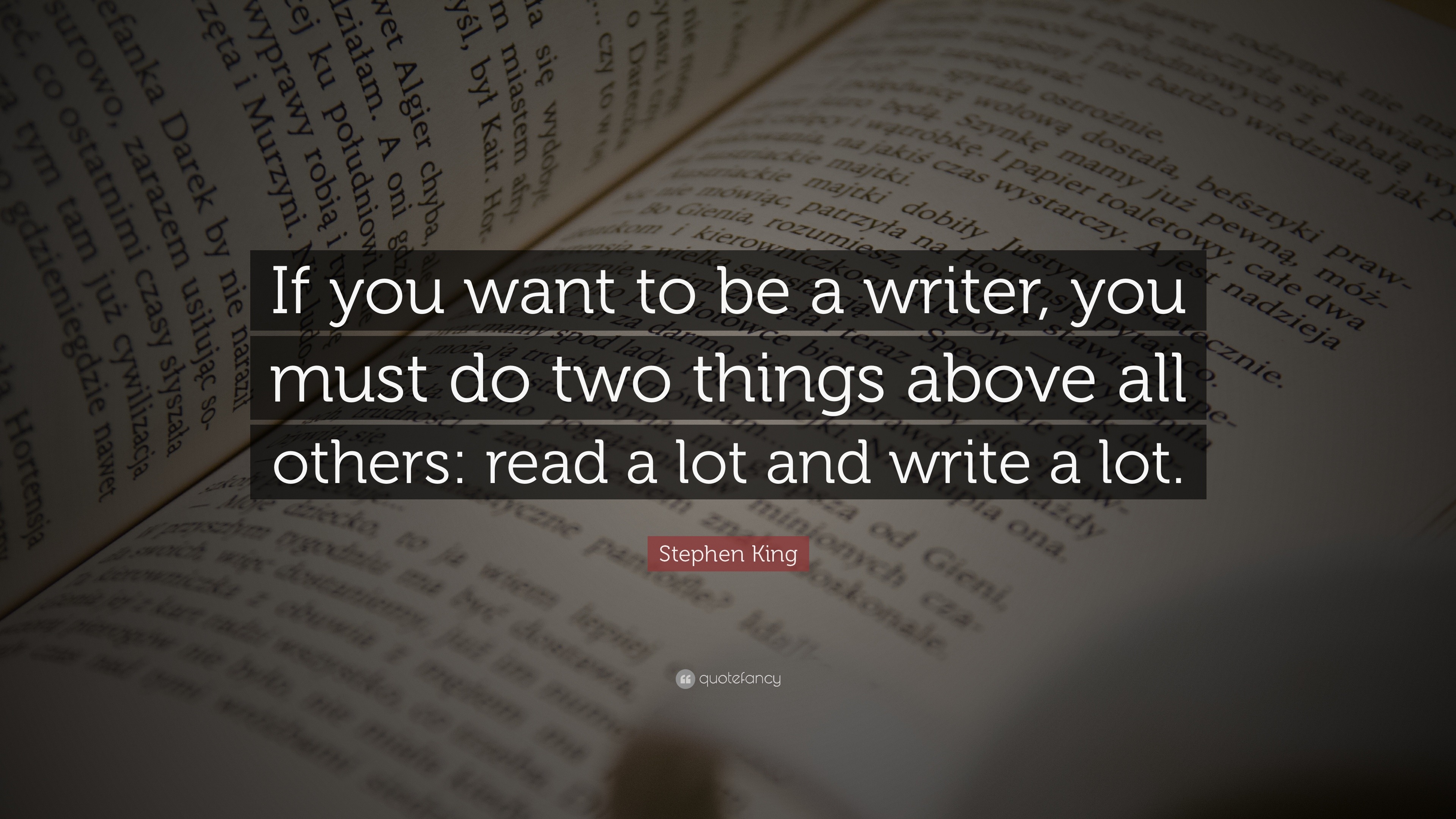
Today I got a marketing email from a writing program that opened by attacking a famous piece of advice from Stephen King’s On Writing.
The quote was this:
“If you want to be a writer, you must do two things above all others: read a lot and write a lot.”
The email framed that advice as harmful. The writer claimed it was the kind of advice that made him quit writing for years.
But honestly?
I disagree.
I do think “read a lot and write a lot” is important advice. I just think it’s incomplete.
Because no, simply reading a lot and writing a lot will not magically make someone a good writer.
But they are essential parts of becoming one.
Reading Alone Isn’t Enough
The first problem is that “read a lot” is too vague.
I’ve worked with authors who claimed to read constantly but had never read a single comp title for the kind of book they were trying to write.
That’s a problem.
If you want to write fantasy, romance, thrillers, horror, literary fiction, or anything else, you need to read heavily inside that space. You need familiarity with reader expectations, genre conventions, pacing patterns, character archetypes, scene structure, emotional payoffs, and market trends.
But even that isn’t enough.
You also need to read craft books.
Read books that actually teach writing technique and story construction. Read them actively. Take notes. Study the concepts. Then go back and reread the books you love through that lens.
Because passive reading and analytical reading are not the same thing.
Some people can absorb storytelling instinctively through sheer exposure. But instinct alone usually isn’t reliable or repeatable.
If you don’t understand why something works, you’ll struggle to reproduce it consistently in your own writing.
“Reading a Lot” Doesn’t Automatically Create Expertise
One of my best friends reads constantly— fifty or more books a year, mostly romantasy.
But as she says herself, she’s “here for the vibes.”
She’s not studying structure. She’s not analyzing scene turns, genre obligations, or emotional payoff sequences. She’s just enjoying the experience as a reader.
And there’s nothing wrong with that.
But consuming huge amounts of romantasy doesn’t automatically make someone an expert in writing romantasy.
She could absolutely tell you which books she loves.
But she couldn’t clearly articulate:
- the genre expectations of romantasy readers
- why a certain book failed for her
- where a story structurally broke down
- or how to fix it
If she decided tomorrow that she wanted to become a romantasy author, she would need to:
- Study craft
- Learn story structure and genre mechanics
- Reread her favorite books critically
- Analyze how those books create their effects
- Then intentionally apply those lessons in her own writing
That’s a very different process from simply reading a lot.
Writing Alone Isn’t Enough Either
The same thing applies to writing.
Yes, you absolutely need to write a lot.
You need repetition.
You need experimentation.
You need practice.
Sometimes you need to write a scene three different ways to figure out which version actually works. Sometimes you need to rewrite a scene entirely after realizing the emotional turn isn’t landing.
That’s normal.
But writing thousands of words without improvement strategies doesn’t automatically make someone better.
I once worked with a client who wrote every single day. Extremely disciplined. Consistent word counts. Thousands upon thousands of words.
But the grammar and sentence construction were so weak that parts of the manuscript were genuinely difficult to understand. Structure wasn’t part of the writing at all.
In that situation, “just write more” wasn’t the solution.
He needed to learn foundational writing mechanics first.
If someone writes a thousand words a day of confusing, unreadable prose for five years, they haven’t trained themselves to write well. They may have just trained themselves to repeat bad habits more efficiently.
Practice matters.
But directed practice matters far more.
The Missing Piece: Intentional Study
So no—I don’t think Stephen King’s advice is wrong.
I think it’s correct.
It’s just simplified.
You do need to read a lot.
You do need to write a lot.
But you also need to:
- study craft
- read intentionally
- analyze critically
- apply what you learn
- experiment
- revise
- and develop awareness of what actually creates specific effects on readers
That’s the difference between consuming stories and learning how to build them.
Some Craft Books I Recommend
A few craft books I regularly recommend to writers:
- Save the Cat! Writes a Novel by Jessica Brody
- Structuring Your Novel by K. M. Weiland
- Creating Character Arcs by K. M. Weiland
- Story by Robert McKee
- Dialogue by Robert McKee
- Wired for Story by Lisa Cron
- The Fantasy Fiction Formula by Deborah Chester
- Writing Active Hooks by Mary Buckham
Read them.
Then go study the books you love with their principles in mind.
Then write.
Then revise.
Then repeat.
Because you will never become a good writer without writing.
And you will never consistently write books people want to read if you are not actively reading and studying storytelling yourself.
If you want help accelerating that process, that’s where writing and scene coaching can help. Sometimes the fastest way to improve is to have someone identify the problems you can’t yet see yourself.
If you’re interested in working with me, you can fill out my intake form and schedule a free discovery call to see whether we’d be a good fit.
Leave a Reply